Years ago, I had an opportunity to interview for a senior sales leadership position. At the time, I was among the stronger producers in my organization, and my performance suggested that I had earned the opportunity to be considered. Unfortunately, professional opportunities have a habit of arriving without consulting the rest of our lives. My first son had just been born, my wife was recovering, I was completing demanding professional courses, and sleep had become something I remembered rather than something I regularly experienced.
I went into that interview exhausted, distracted, and considerably less prepared than I should have been. It showed. Whatever my performance record suggested about my capabilities, I did a remarkably poor job of demonstrating them that afternoon. I didn’t get the position, and I understood why.
At the time, the disappointment was significant. I had spent years developing my professional abilities, yet a relatively brief interaction had become the deciding factor in an opportunity I genuinely wanted. Looking back, however, I cannot reasonably fault an organization for evaluating what it could observe. An interview is an imperfect assessment, but employers still have to make decisions using the information available to them. My responsibility was to present myself effectively, and on that occasion, I hadn’t.
What stayed with me was a broader question about how organizations evaluate human capability.
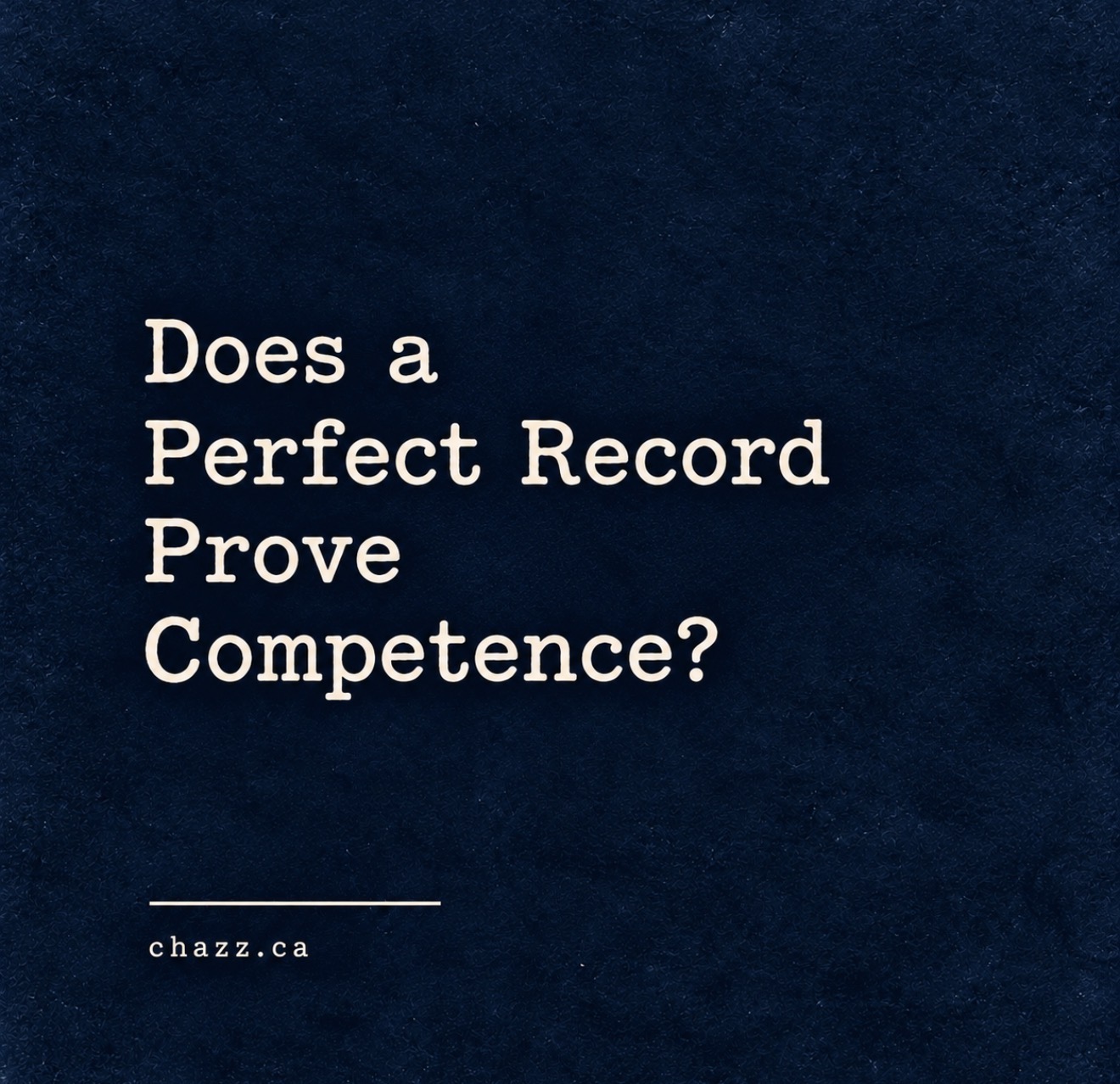
We place considerable emphasis on professional records because they provide useful evidence. Qualifications, previous accomplishments, performance history, and interview results help employers reduce uncertainty when making consequential hiring decisions. There is nothing inherently wrong with that approach. The difficulty arises when we begin treating these indicators as complete representations of a person’s competence rather than imperfect measures of it.
A consistently strong record tells us something about what an individual has accomplished under particular circumstances. It does not necessarily tell us how that person will respond when those circumstances change. Equally, a disappointing performance may reveal a genuine limitation, a temporary disruption, inadequate preparation, or some combination of the three. The challenge for anyone evaluating talent is distinguishing between those possibilities.
I have become particularly interested in what happens after someone experiences a setback. Failure itself is not a qualification, and I am skeptical of the popular tendency to romanticize it. Some people encounter difficulty and become more thoughtful, disciplined, and capable. Others repeat the same mistakes while developing increasingly elaborate explanations for why the outcome was beyond their control. The experience alone does not establish which direction someone has taken.
What matters is whether the experience produces meaningful learning.
In my own case, that interview changed how I approached preparation and professional communication. It also influenced how I came to evaluate other people. I became more conscious of the difference between someone’s underlying capability and their performance in a particular moment, without losing sight of the fact that performance still matters. Understanding someone’s circumstances can provide valuable context, but it does not automatically excuse an inadequate result.
Not long afterward, my career moved in a different direction. Rather than pursuing another conventional advancement opportunity, I eventually took on the uncertainty of business ownership. That decision led to the agency I operate today. I would not suggest that failing the interview caused my subsequent success, or that the alternative path would necessarily have been worse. Those are conclusions we cannot know. What I can say is that the experience influenced how I approached the opportunities and responsibilities that followed.
There is a practical implication here for organizations, particularly when evaluating people for leadership positions. A polished candidate with an impressive record may be exceptionally capable. Someone whose career includes setbacks may be equally capable, or they may not be. Neither the absence nor the presence of failure is sufficient evidence of resilience, judgment, or adaptability.
A more useful distinction emerges when we examine how individuals respond to difficulty. Did they recognize their contribution to the outcome? Can they identify what changed in their approach afterward? Is there subsequent evidence that their judgment or execution improved? Those signals reveal considerably more about professional development than the simple fact that someone succeeded or failed.
This is not an argument for lowering hiring standards or overlooking poor performance. Organizations have legitimate obligations to evaluate competence carefully, particularly when responsibilities involve people, capital, and consequential decisions. It is an argument for recognizing that competence is multidimensional, and that a single assessment cannot always capture the full range of what someone may contribute.
I still remember that interview, although the disappointment has long since disappeared. It remains useful to me because it challenged how I understood both professional performance and personal development. I learned that a strong record does not entitle someone to an opportunity, and that a poor performance does not necessarily establish the limits of their future capability.
Perhaps the most revealing part of someone’s professional history is not whether they have encountered failure, but what their subsequent decisions tell us about how they understood it.
A record tells us what someone has achieved. Their response to adversity tells us something about who they may become.





I am a Canadian business owner with a longstanding interest in leadership, strategy and decision making. I write about business, risk, leadership and the systems and incentives that shape how people and organizations make decisions.
Chazz.ca is my personal writing project and a place to explore ideas drawn from experience, education, reading and conversations with people building and leading organizations.
Leave a Reply