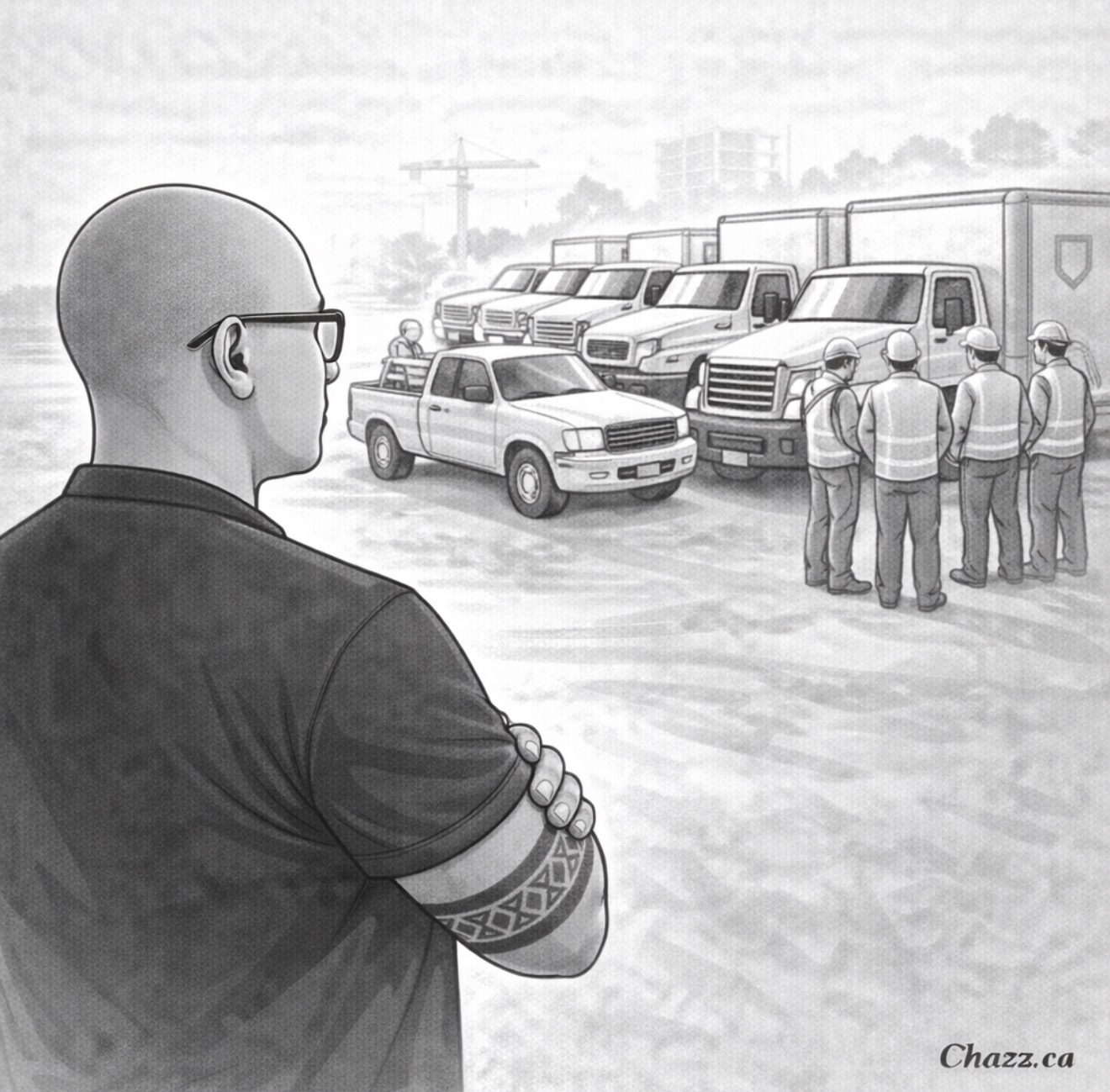
A while ago I sat down with a client who owns a contracting company in our region. If you drove past one of his sites today you would see trucks, crews, supervisors moving in different directions, and projects happening all at once. The company employs more than one hundred and fifty people now.
But it did not start that way.
When he first launched the business it was just him and his wife. He handled the work. She handled the phone calls, the invoices, and the scheduling from a desk that sat in the corner of their living room. The first truck was older than the company itself. The first contracts were small enough that he could personally show up and complete the work himself.
Back then the risks were simple. If something went wrong he would deal with it directly. If a project ran late he worked longer hours. If equipment broke he fixed it himself. The business was small enough that the owner was the system.
Years passed and the company grew.
One employee became five. Five became twenty. Twenty became fifty. Then came supervisors, project managers, and entire crews operating at the same time. Contracts got larger. Equipment fleets expanded. Clients began expecting guarantees, timelines, and accountability that only structured organizations can deliver.
What fascinated me was not the growth itself. It was the moment he described when he realized something had quietly changed.
He told me there was a point where he woke up one morning and understood that the company no longer depended only on his work. It depended on systems, decisions, and people he could not personally oversee every minute of the day.
In management language, that is the moment a business stops being small.
Revenue might grow steadily for years, but there is an invisible threshold where operational complexity begins to multiply. One job site becomes five. One truck becomes thirty. One decision made by the owner becomes dozens of decisions made by employees across different locations.
And with that complexity comes risk.
The risk is no longer just about whether the work gets done. It is about liability on job sites, contractual obligations, equipment exposure, employee safety, and the ripple effects that one unexpected event can have across an entire organization.
Many businesses cross this threshold without noticing.
The company grows. The projects get larger. The payroll expands. But the protection structure often stays exactly where it was when the business was still small.
From a strategy perspective this creates fragility. Growth multiplies opportunity, but it also multiplies exposure. A lawsuit, an accident, or a contractual dispute can affect far more than the owner who once ran jobs alone. It can affect employees, families, partners, and years of hard work that built the company.
The most successful owners I work with eventually understand something important.
Insurance is not simply a policy sitting in a file. It is part of the architecture of the business. It is the structure that ensures one event does not undo a decade of effort.
The contractor I mentioned earlier understood this as his company evolved. The questions he began asking changed completely. He stopped asking what the cheapest option was and started asking whether the structure actually matched the scale of the business he had built.
That shift in thinking is often what separates companies that endure from those that struggle when something unexpected happens.
Because growth changes everything.
The day a business stops being small is exciting. It means the work is paying off and the vision is becoming real.
But it also introduces a new responsibility.
The responsibility to make sure the structure protecting that business grows at the same pace as the business itself.
The strongest leaders understand this early.
They know that building something valuable is only half the job.
Protecting it is the other half.





I am a Canadian insurance and investment professional and the President and Chief Executive Officer of Chazz Financial Inc. and Chazz Capital Assets. I write about leadership, markets, insurance, investing, and decision making, with a focus on how structure and incentives shape outcomes.
I hold a business degree and I am a Fellow of the Canadian Securities Institute (FCSI®), a Chartered Life Underwriter (CLU®), a Chartered Financial Planner®, a Certified Health Specialist and a Mutual Fund Investment Representative.
Leave a Reply