
I have sat at a few tables recently with people who work in wealth management and retirement planning. Smart people. Experienced people. People who understand markets, cycles, and risk. Some support the current government in the United States. Some do not. But there is a phrase I keep hearing that stops the conversation cold.
We are making money right now.
On the surface, it sounds rational. Markets are up. Portfolios are growing. Statements look good. From a narrow financial perspective, the conclusion feels justified. But this is where short term performance becomes a blindfold, and where good professionals can miss the larger system they are operating inside.
In economics, we distinguish between flow and stock. Flow is what is happening now. Stock is what has been accumulated and what enables future flows. A business can show strong quarterly revenue while quietly eroding its productive capacity. A country can show growth while weakening the institutions that make growth repeatable. These are not contradictions. They are warning signs.
When investors say they are making money right now, they are describing a flow. They are not describing resilience.
In strategy, we talk about leading indicators and lagging indicators. Markets are lagging indicators. They respond after conditions have already changed. By the time capital prices reflect structural damage, the damage is already embedded. This is why risk managers do not wait for losses to appear. They look for fragility. They look for concentration. They look for governance breakdowns. They look for policy uncertainty. They look for signals that the system is becoming harder to trust.
This is not ideology. It is systems thinking.
At the same time, it is important to say something clearly, especially for clients and investors who may read this. Historically, markets over long periods of time have trended upward, though results are never guaranteed and outcomes depend on time horizon, discipline, and strategy. Over the last century, broad equity markets have rewarded patience, consistency, and long term planning. The upward line on a hundred year Andex chart is real, and it remains one of the most powerful arguments for disciplined investing.
But that chart only tells part of the story.
Markets reward time, not timing. They reward planning, not speculation. They reward people who understand their own risk tolerance and build strategies that match it. Investing was never meant to be a shortcut to sudden wealth. It is a long term partnership between discipline, patience, and structure. That is why the role of a skilled advisor matters. Not to predict markets, but to design a plan that can survive them.
Strong economies are built on predictability, credibility, and institutional continuity. Strong portfolios are built the same way. When those weaken, the cost of capital rises even if markets do not immediately reflect it. Entrepreneurs delay decisions. Talent hesitates. Long horizon projects get shelved. Innovation becomes defensive instead of expansive. These are opportunity costs that never show up on a statement. They show up as absence.
I think about this as negative space risk. The risk of what will not happen because conditions no longer support it. The company that never gets started. The immigrant who takes their idea elsewhere. The student who chooses a different country. The technology that never gets built. These losses are invisible, which is why they are so dangerous.
In wealth planning, we warn clients about sequence risk. The risk of bad timing early in retirement that permanently alters outcomes. Nations face the same issue. Policy decisions made in moments of strength can permanently reduce future options if they undermine the system that produced the strength in the first place. The same is true of portfolios built without intention. Growth without structure creates fragility.
This is why the phrase we are making money right now is not comforting. It is incomplete. It is the language of people measuring the present while discounting the future. It is the mindset of someone looking at returns without looking at the engine that produces them.
The most important question is not whether money is being made today. It is whether the conditions for making money tomorrow are being protected, and whether the plan in place matches the life it is meant to support.
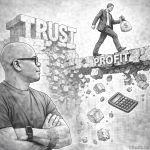
History is full of moments where people confused profit with progress. They look identical until they are not. And by the time the difference is obvious, it is already too late to correct cheaply.
Real stewardship is the ability to look beyond the statement, beyond the quarter, beyond the market noise, and ask a harder question. What kind of system are we building. What kind of future are we funding. What kind of plan are we trusting to carry us there.
This is not a forecast. It is a reminder that good planning is built on structure, patience, and alignment, not prediction.
That is fiduciary thinking at its highest level.
And it is the responsibility of anyone who claims to manage wealth, not just grow it.




I am a Canadian business owner with a longstanding interest in leadership, strategy and decision making. I write about business, risk, leadership and the systems and incentives that shape how people and organizations make decisions.
Chazz.ca is my personal writing project and a place to explore ideas drawn from experience, education, reading and conversations with people building and leading organizations.
Leave a Reply