I often hear a recurring question from people who otherwise seem quite intelligent. “Why can’t we just let it go? Why is history still a part of the professional conversation?” They claim to value equality. They claim to care about the success of their colleagues. Yet they seem fundamentally incapable of grasping why a system doesn’t reset to zero just because a law was signed.
Here is a data point to dismantle that line of thinking.
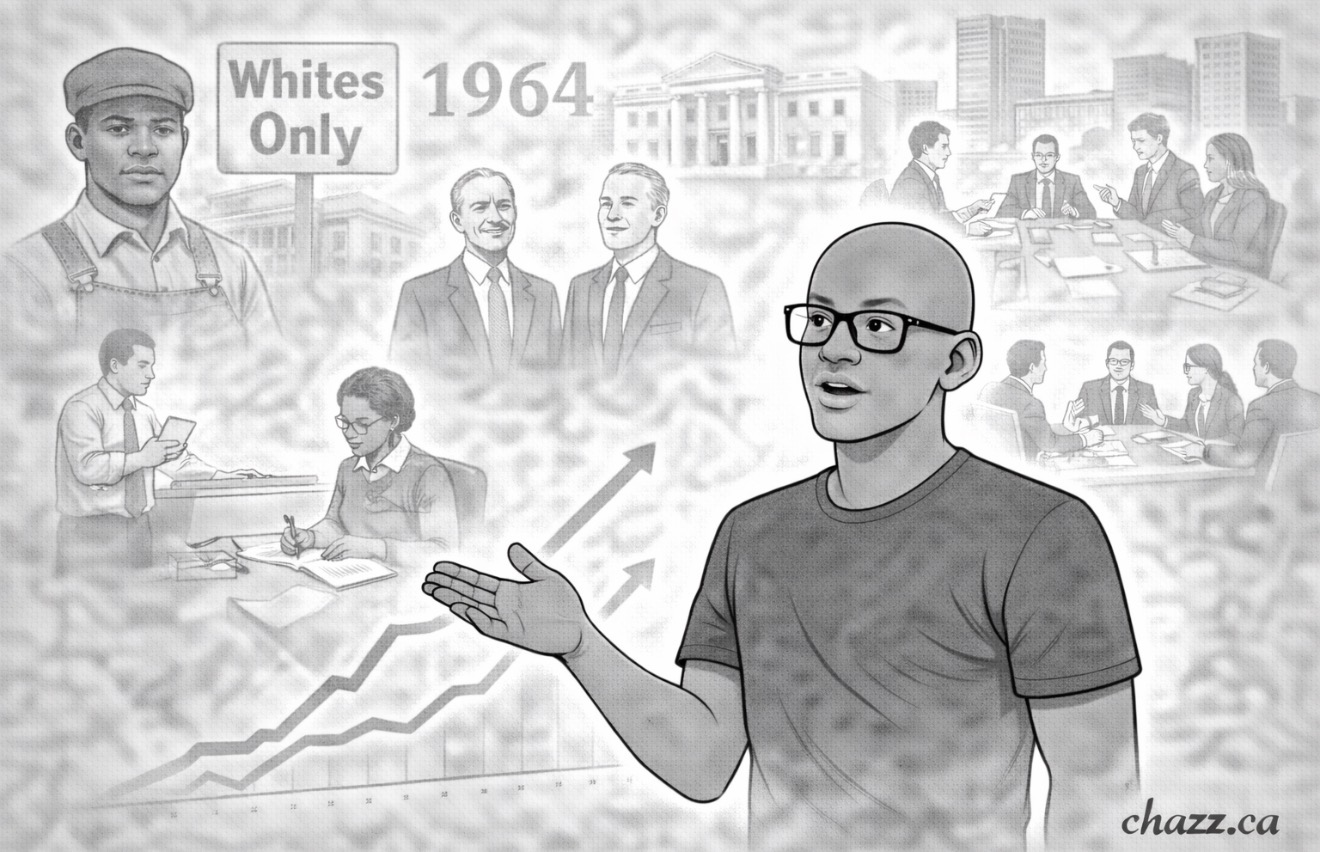
The first generation of Black people born in North America with full, codified equal rights is less than sixty years old. To put that in perspective, that is a single career cycle. Many of the people currently sitting in executive suites or managing global portfolios were born before this legal baseline even existed. This isn’t ancient history. It is a current operational reality.
In management terms, we are talking about institutional legacy costs. You don’t take a company that has operated under a flawed, exclusionary model for a century, change the mission statement on a Monday, and expect a high performing culture by Tuesday. That is not how organizational behavior works.
When you ignore the context of that sixty year window, you are ignoring the compounding interest of exclusion. In the world of wealth management and insurance, we understand that time is the most powerful variable. If one group is barred from the market for centuries and another group is given a head start, the resulting gap isn’t just a coincidence. It is a structural reality. To tell a group that started a hundred miles back to just get over the head start is not logic. It is strategic gaslighting.
From a risk management perspective, ignoring this history is a failure of due diligence. You cannot accurately assess the current landscape if you refuse to acknowledge the soil it was built on. Bias and racism aren’t just social issues. They are systemic inefficiencies. They are the friction points that prevent a market or an organization from reaching its full potential.
When people ask to let it go, what they are really asking for is a comfortable silence that allows them to ignore their own unearned advantages. They are asking others to subsidize their peace of mind with a form of historical amnesia.
True excellence doesn’t require us to ignore the past. It requires us to outwork it.
The leaders who truly move the needle in 2026 aren’t the ones looking for a shortcut to comfort. They are the ones who understand the weight of the moment. We are watching the first generation to truly hold the pen in a supposedly equitable system. That creates a massive fiduciary duty for all of us to ensure the infrastructure actually supports the promise.
To those still struggling with these simple concepts. Empathy is not a soft skill. It is a cognitive requirement for leadership. If you can’t see the timeline, you can’t see the risk. And if you can’t see the risk, you aren’t leading. You are just taking up space.
The future belongs to the ones who have the clarity to face the truth and the excellence to build something better anyway.





I am a Canadian insurance and investment professional and the President and Chief Executive Officer of Chazz Financial Inc. and Chazz Capital Assets. I write about leadership, markets, insurance, investing, and decision making, with a focus on how structure and incentives shape outcomes.
I hold a business degree and I am a Fellow of the Canadian Securities Institute (FCSI®), a Chartered Life Underwriter (CLU®), a Chartered Financial Planner®, a Certified Health Specialist and a Mutual Fund Investment Representative.
Leave a Reply