I had a conversation recently that left me thinking about the difference between what we are capable of learning and what we are actually capable of doing today.
It was a small moment, and ultimately an inconsequential one. I was asked about a capability that I do not consider one of my professional strengths. I said as much. I also believed, quite genuinely, that if circumstances ever required me to develop it, I probably could. Somewhere in the conversation, however, those two ideas moved a little too close together.
People who have experienced some measure of professional success are often rewarded for believing they can figure things out. Entrepreneurs in particular spend years operating beyond the boundaries of what they already know. You encounter a problem, learn enough to understand it, find the right people, develop the necessary skills, and move forward. Over time, “I can figure this out” becomes part of your professional identity.
For the most part, that confidence is an asset. I am not sure I would have built much of anything without it.
But there is an important distinction between believing you can develop a capability and accurately representing the capability you possess today.
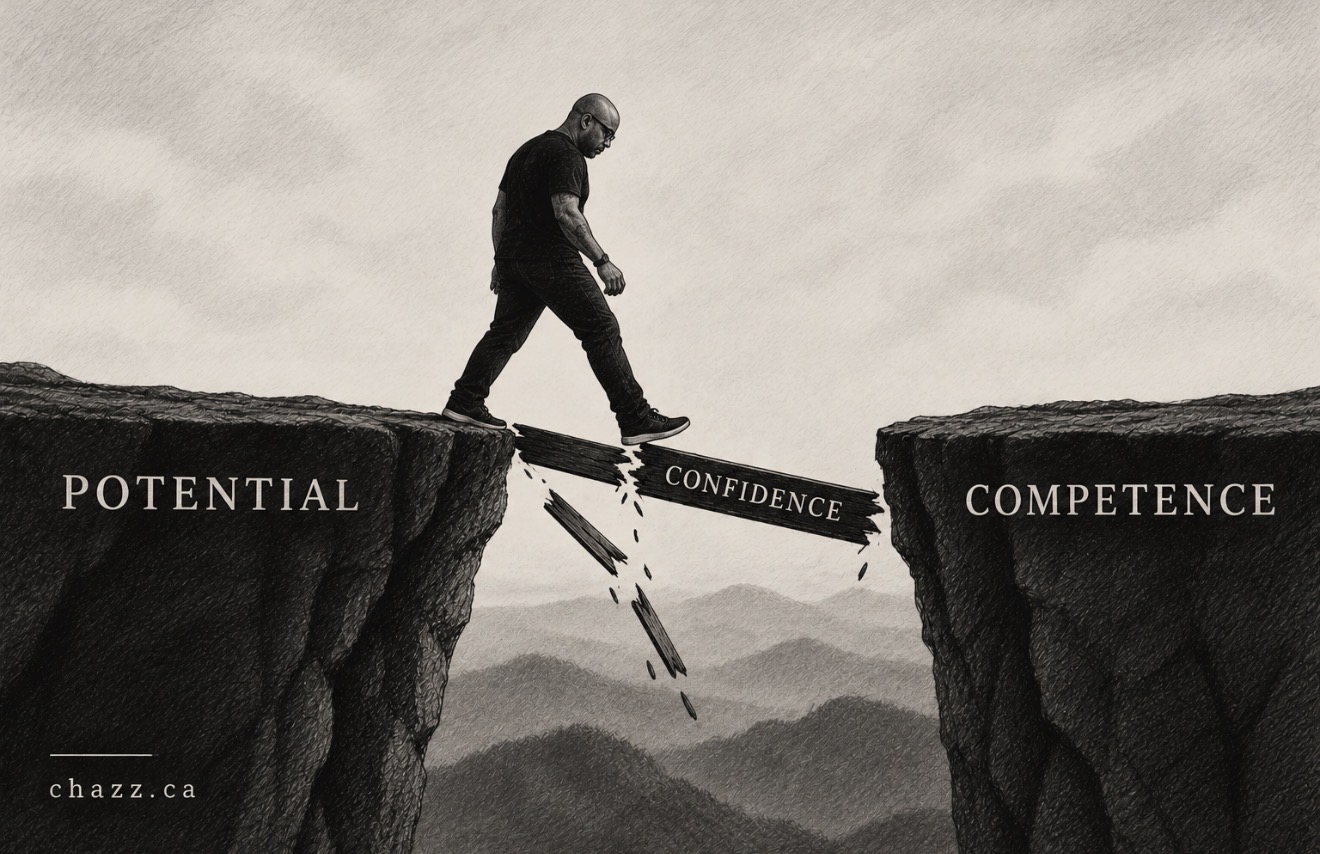
Potential is forward looking. Competence is present tense.
The distance between those two things is where calibration matters.
I have become increasingly interested in calibration as a leadership skill because confidence receives considerably more attention. We admire leaders who make decisions, enter unfamiliar situations, and believe they can solve difficult problems. Those qualities matter. Yet confidence without calibration can become surprisingly dangerous because the person expressing it may not even believe they are overstating anything.
They are simply describing tomorrow’s potential as though it were today’s capability.
That distinction becomes more consequential as responsibility increases. An executive who believes a struggling division can be repaired may be demonstrating vision. An executive who represents that division as healthy because they are confident they can repair it is doing something entirely different. A leader may reasonably believe a team can deliver an ambitious project, but that belief should not become a statement that the necessary capabilities already exist. The same principle applies to forecasts, acquisitions, technology implementations, hiring decisions, and almost every other area where optimism and execution intersect.
There is another psychological problem. Once we state something confidently, correcting ourselves can feel more uncomfortable than continuing.
The first overstatement may be innocent. Perhaps we understood the question differently. Perhaps we genuinely believed our capability was stronger than it was. Perhaps we simply reached a little too far in the moment. The more important test of credibility is what happens when reality provides better information.
Can we say, “Let me qualify what I just said”?
That sentence requires surprisingly little effort and, occasionally, a surprising amount of maturity.
Leadership culture is shaped by these moments. When senior people can acknowledge uncertainty, specialists become more comfortable challenging assumptions. Managers surface problems earlier. Forecasts become more useful because people are not protecting previous predictions. An organization becomes less interested in appearing correct and more interested in becoming correct.
None of this means leaders should become timid about their potential. I still believe there is enormous value in looking at something you cannot do today and thinking, “I can learn that.” Much of human progress depends on precisely that kind of confidence.
The discipline is keeping the tense correct.
“I can learn this” is ambition.
“I can do this” is a statement of present capability.
Strong leaders should be comfortable saying both, but they should know which one is true.
A recent conversation reminded me that even after years of leading businesses, building teams, and making consequential decisions, that distinction still requires attention. I am glad it did. Small moments have a useful way of exposing larger principles if we are willing to examine them rather than defend them.
Perhaps that is ultimately what credibility requires. Not perfection, and certainly not knowing everything. It requires enough confidence to believe in what we can become, while remaining honest about where we are today.
Potential has no fixed boundary. Competence does. Credibility is knowing the difference.





I am a Canadian business owner with a longstanding interest in leadership, strategy and decision making. I write about business, risk, leadership and the systems and incentives that shape how people and organizations make decisions.
Chazz.ca is my personal writing project and a place to explore ideas drawn from experience, education, reading and conversations with people building and leading organizations.
Leave a Reply