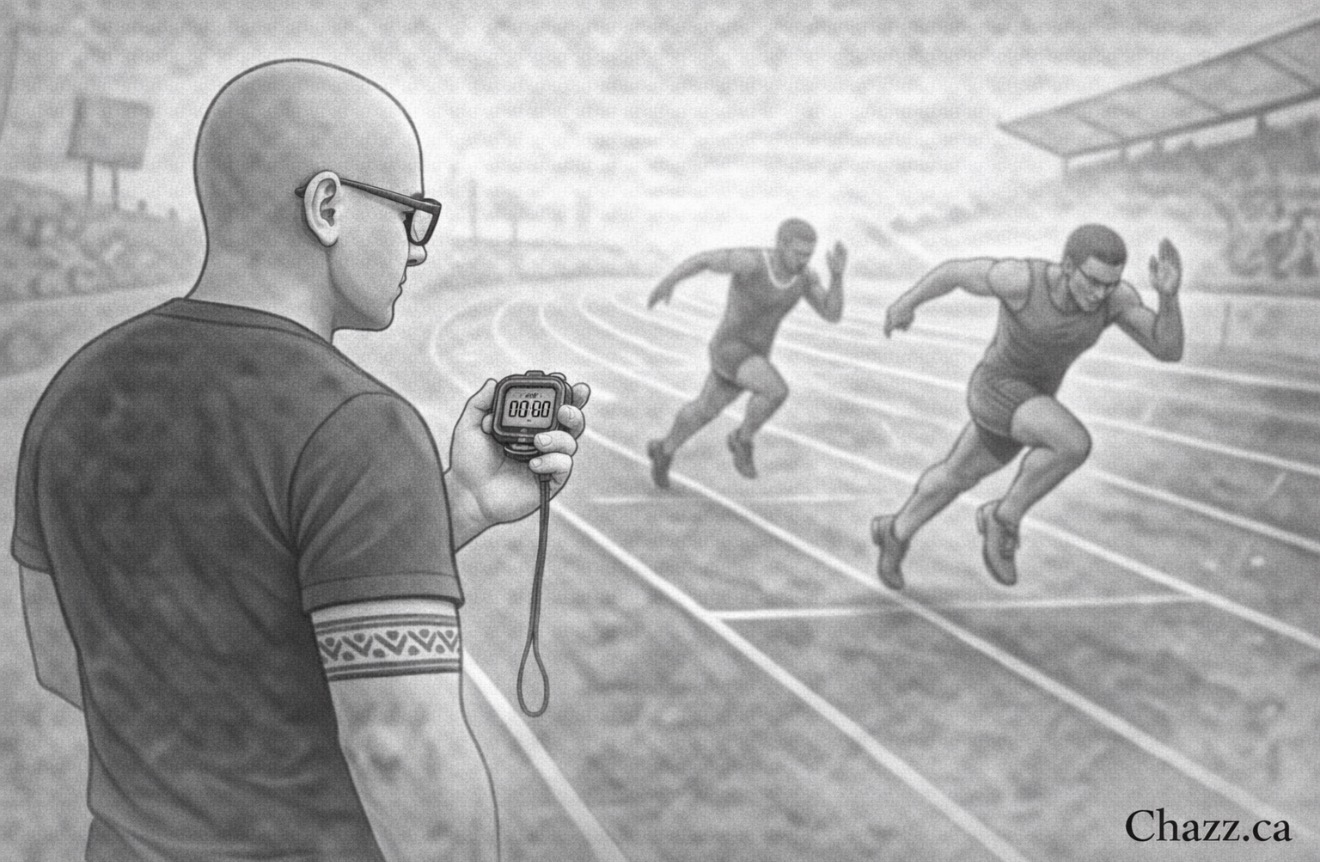
I was at the gym today, in between sets, watching a video of Miami defensive back Keionte Scott running an unofficial 4.25 forty. It was the kind of speed that makes you pause mid workout and watch it again. Naturally, I did what most people do next. I went into the comments.
Immediately, people started bringing up Usain Bolt. There were breakdowns of race phases, arguments about acceleration versus top end speed, and confident takes about how Bolt would not even win the first forty. Everyone had an opinion. Everyone had a perspective. And reading through it, something clicked for me.
That is exactly how most people experience life. They judge the first forty.
In business, in careers, and in relationships, people are constantly measuring the early stretch. The visible start. The initial results. If it looks slow, they assume it is failing. If it feels hard, they assume something is wrong. And then something even more damaging happens. They start to make it worse.
They hesitate. They second guess. They pull back effort. They start telling themselves a story about why it is not working. It is not the slow start that causes the failure. It is what comes after.
There is a question I came across recently that stuck with me. Can you make it worse? It sounds simple, but it is incredibly revealing. Is there something you can do right now that would slow your progress, degrade your results, or create unnecessary friction? Of course there is. You can doubt yourself at the wrong moment. You can listen to the wrong voices. You can focus on the wrong metrics. You can abandon the process too early.
Most people do not lose because they were behind. They lose because they turned being behind into something permanent.
If you have ever worked with me, or been inside any of my businesses, you would understand something that is not obvious from the outside. Almost every year starts the same way. Slow, messy, and uncertain. From the outside, it might look like things just work, like momentum is natural, like results are consistent. They are not.
There is a constant process of recalibration. Adjusting strategy. Refocusing attention. Ignoring noise. Reinforcing discipline. It is not dramatic and it is not loud, but it is intentional.
Because the difference between people who figure it out and people who do not is rarely talent. It is how they interpret the early part of the race.
Some people see a slow start and assume they are losing. Others understand they are still accelerating. That shift in thinking changes everything.
In business and in risk, we talk about compounding effects. Small decisions, repeated over time, create outcomes that look disproportionate to the effort. The same applies here. If you respond to early struggle by making things worse, the compounding works against you. If you respond by staying disciplined, adjusting intelligently, and continuing to execute, the compounding eventually works in your favor.
The truth is, most people never get to see what they are capable of. Not because they lacked ability, but because they misread the first forty. And by the time they realized it was not a sprint, they had already stepped off the track.
So the next time things feel slow, or unclear, or harder than expected, ask a better question. Are you actually losing, or are you just early?
Because those are not the same thing. And the people who understand that distinction are usually the ones who finish strong.





I am a Canadian insurance and investment professional and the President and Chief Executive Officer of Chazz Financial Inc. and Chazz Capital Assets. I write about leadership, markets, insurance, investing, and decision making, with a focus on how structure and incentives shape outcomes.
I hold a business degree and I am a Fellow of the Canadian Securities Institute (FCSI®), a Chartered Life Underwriter (CLU®), a Chartered Financial Planner®, a Certified Health Specialist and a Mutual Fund Investment Representative.
Leave a Reply