
There is an old pattern in human behavior that shows up in many places. People often prefer a simple answer that feels right over a slightly more complex answer that is actually correct.
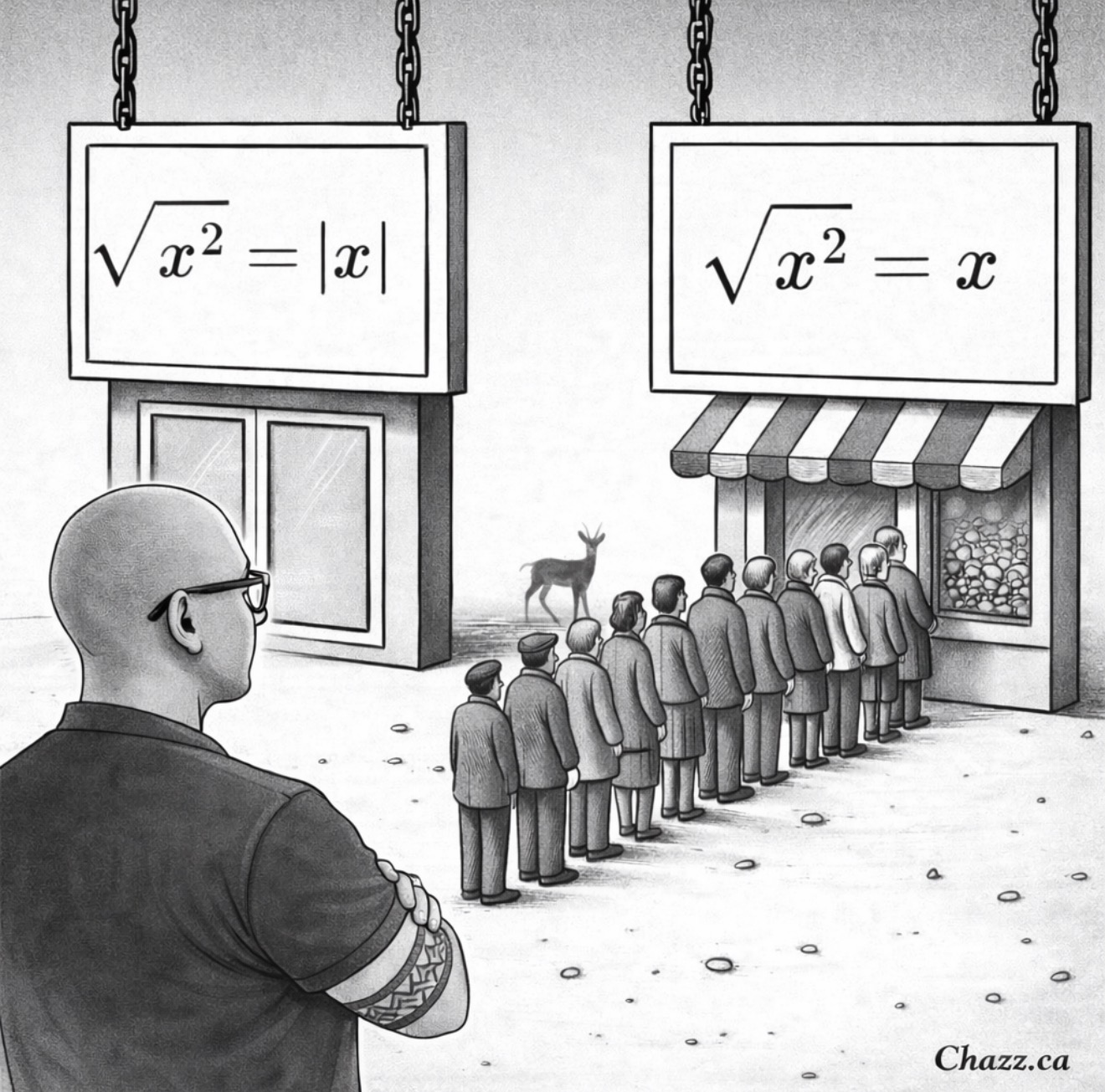
The image circulating recently captures this perfectly. Two signs show a mathematical statement. On one side the equation is written correctly: the square root of x squared equals the absolute value of x. On the other side the equation is simplified to say the square root of x squared equals x.
Most people line up for the simplified version.
It feels cleaner. It feels easier. It looks right at first glance.
But it quietly ignores something important. Negative numbers exist. The correct expression requires the absolute value because the square root of a squared number is not always simply the original number.
The deer standing between the two buildings in the drawing represents the observer who notices the mistake and chooses not to join the crowd.
It is a clever little commentary on human thinking.
Crowds gravitate toward the explanation that feels intuitive. Careful reasoning requires a pause, a bit more thought, and the willingness to examine the conditions that make something true.
This pattern shows up everywhere, including in financial advice.
There is a phrase that gets repeated constantly in the insurance and investment world: “Buy term and invest the rest.” It is presented as if it were a universal law. A neat, clean formula that applies to everyone.
It sounds elegant. It sounds efficient. And like many simple answers, it feels satisfying.
But real financial planning is not a slogan.
Different families have different tax structures, different estate goals, different risk tolerances, and different timelines. Business owners often have liquidity needs, succession planning concerns, and tax exposure that change the equation entirely. Permanent insurance can serve purposes that term insurance cannot replicate. It can create predictable liquidity, stabilize estate planning, or act as a strategic financial asset within a broader plan.
None of that fits neatly into a four word rule.
This does not mean term insurance is wrong. In many cases it is exactly the right tool. But presenting a single strategy as universally correct ignores the complexity of real lives and real businesses.
In strategy and risk management we learn something early. Oversimplification is comfortable, but it is rarely accurate.
The best decisions rarely come from slogans. They come from understanding the variables, asking better questions, and designing solutions that actually match the situation in front of you.
Crowd thinking prefers simple formulas.
Leadership requires something else.
The willingness to pause, notice the nuance, and resist the urge to line up for the answer that simply feels easiest.





I am a Canadian business owner with a longstanding interest in leadership, strategy and decision making. I write about business, risk, leadership and the systems and incentives that shape how people and organizations make decisions.
Chazz.ca is my personal writing project and a place to explore ideas drawn from experience, education, reading and conversations with people building and leading organizations.
Leave a Reply