
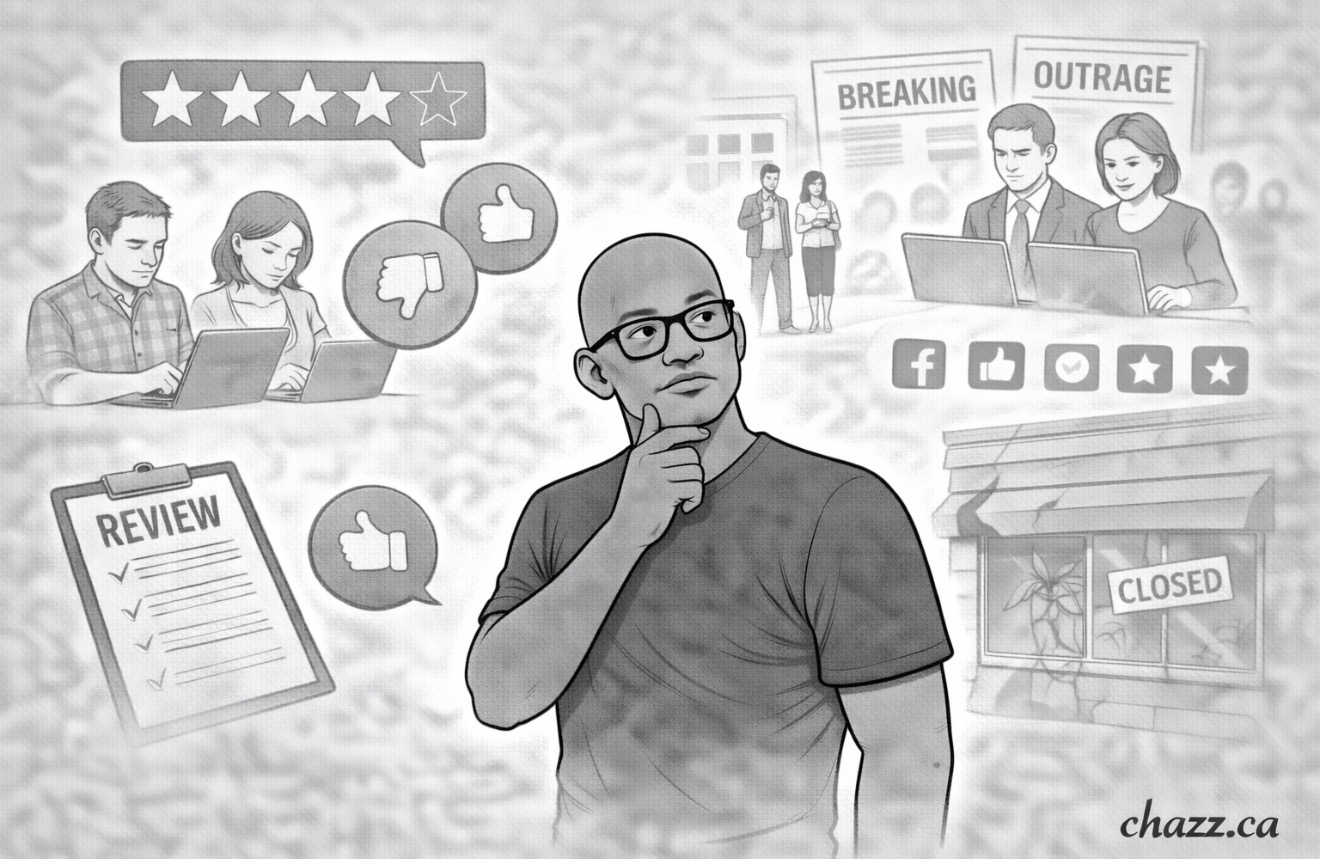
A friend sent me a link last week and asked if I could leave a review for his new business. It had been live for about a week. I paused.
Not because I don’t want to support him. I do. But I value what I say publicly. And more importantly, I understand what a review actually is. It is not encouragement. It is a signal. It is a piece of market data that shapes perception, trust, and decision making. Endorsement without experience is not kindness. It is noise.
In management terms, a review is a reputational asset. It carries weight because it implies exposure, evaluation, and judgment. When that signal is manufactured instead of earned, the system breaks. Customers stop trusting reviews. Businesses start chasing optics instead of outcomes. Leaders begin optimizing for applause rather than performance. This is a classic misalignment problem.
In strategy, we talk about leading indicators and lagging indicators. Reviews are supposed to be lagging indicators. They reflect something that has already happened. A real interaction. A real outcome. A real level of satisfaction or disappointment. When we try to force them early, we convert them into artificial leading indicators that distort reality. The risk is subtle but real.
Organizations that build early credibility on untested praise often struggle later because the feedback loop is corrupted. They don’t learn fast enough. They don’t see their gaps. They don’t refine the product or service based on lived experience. They build a brand narrative before they build operational truth. That creates fragility.
Risk management is not just about avoiding losses. It is about protecting signal integrity. If you cannot trust the data coming into your system, every decision that follows becomes weaker. Markets depend on honest signals. So do relationships. So do teams.
There is also a deeper leadership layer here. When someone asks for a review before the work has matured, what they are really asking for is validation. And validation feels good in the short term. But long term businesses are not built on validation. They are built on iteration, friction, feedback, and proof.
The discipline is in waiting. Waiting until customers have felt the experience. Waiting until the operation has been tested. Waiting until the value has been demonstrated in the real world, not just imagined in the founder’s head.
Because once a reputation is set, it becomes a strategic constraint. If it is built on truth, it compounds. If it is built on hope, it cracks under pressure. The best support we can give new ventures is not applause. It is patience. It is honesty. It is the space to earn trust rather than borrow it.
In a world obsessed with speed, credibility is still built slowly. And the leaders who understand this treat every public word, every endorsement, and every signal as part of a long term risk strategy, not a short term favor. The market eventually finds the truth. It always does.
The real question is whether you are building something that will still deserve the praise when it arrives.





I am a Canadian insurance and investment professional and the President and Chief Executive Officer of Chazz Financial Inc. and Chazz Capital Assets. I write about leadership, markets, insurance, investing, and decision making, with a focus on how structure and incentives shape outcomes.
I hold a business degree and I am a Fellow of the Canadian Securities Institute (FCSI®), a Chartered Life Underwriter (CLU®), a Chartered Financial Planner®, a Certified Health Specialist and a Mutual Fund Investment Representative.
Leave a Reply