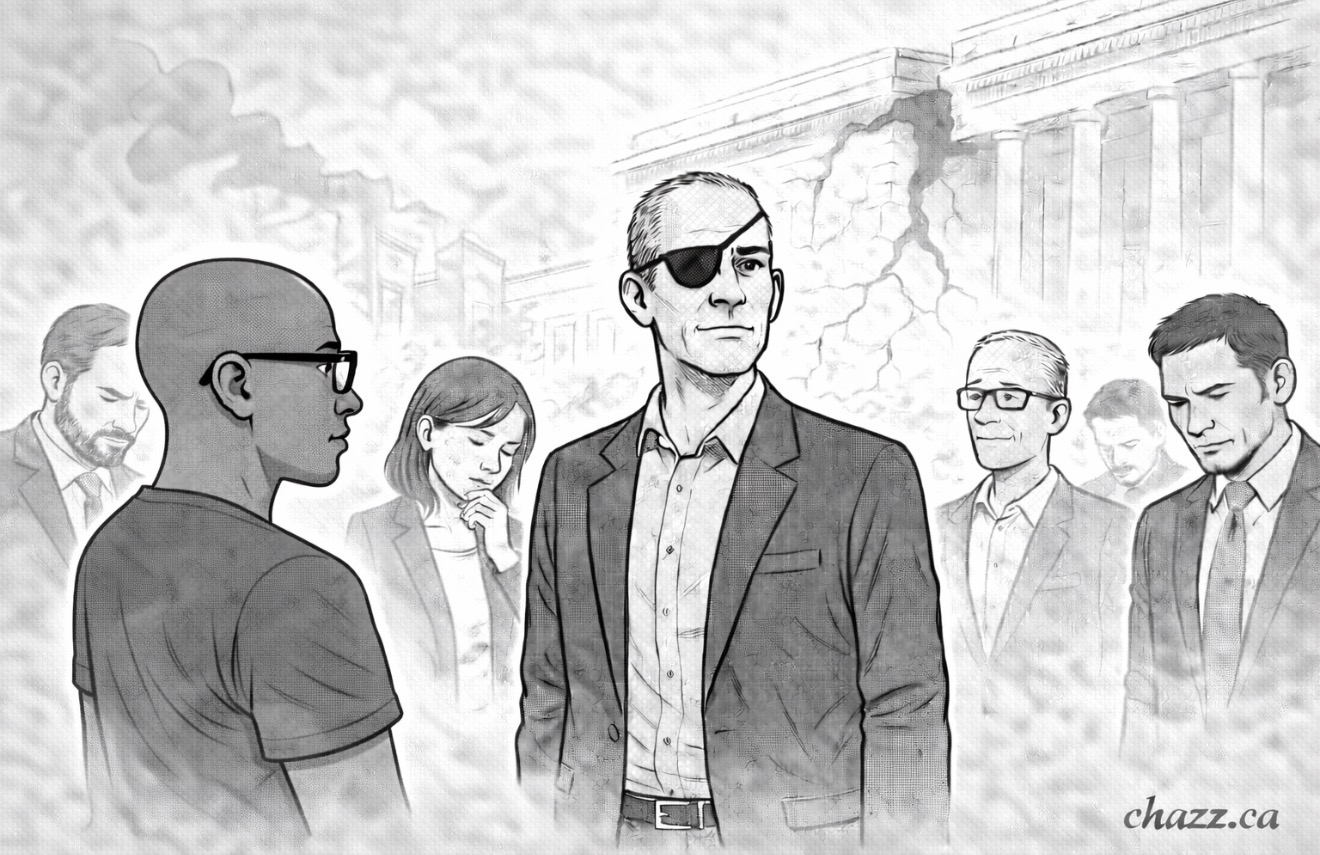
In the kingdom of the blind, the one eyed man is king. This ancient proverb is often interpreted as a celebration of slight advantage, but in the context of 2026, it serves as a warning about the degradation of institutional standards. When a society or an organization loses its collective ability to perceive risk, a leader with even a fractured or half-blind vision can appear to be a visionary. The danger is not just the leader’s lack of sight. It is the silence of those who see perfectly well but refuse to speak.
We see this dynamic playing out currently in the broader societal landscape. Major institutions are being restructured under the guise of efficiency, while the underlying foundations are being systematically dismantled. The most concerning aspect of this era is not the repetition of past failures. It is the eerie quiet from the professional class. This is a classic management failure where the fear of immediate friction outweighs the necessity of long term stability.
In the insurance industry, we manage risk through the lens of probability and impact. We understand that a lack of information is the most dangerous variable in any portfolio. When a leadership team is led by incompetence, the organization begins to suffer from what we call “unmanaged exposure.” If the people within the firm cannot see the systemic issues, they are effectively blind to the cliff they are approaching. A half-blind leader seems clear-eyed to them simply because the baseline for competence has been lowered so significantly.
This is where the parallel between the corporate boardroom and the national stage becomes undeniable. In both arenas, silence is a form of subsidized risk. When talented professionals, lawyers, and strategists stay quiet to protect their current liquidity, they are essentially allowing a “catastrophic loss” event to build momentum. In risk management terms, you are ignoring the “moral hazard” of a leader who has no personal stake in the eventual collapse of the structure.
Unity is not just symbolic. Unity is leverage.
In a fragmented organization, a leader can maintain power by keeping the stakeholders in a state of constant, low-level conflict. But when the silent majority decides to align, the informational asymmetry vanishes. This is the difference between a collection of individual policies and a robust reinsurance treaty. One is a gamble on personal luck. The other is a strategic pooling of resources to survive a systemic shock.
The reality of our current predicament, whether in business or in society, is that we are being tested on our ability to value the collective health over the individual gain. We don’t need a king with one eye. We need a community with its eyes wide open. If we continue to accept the vision of the half-blind because we are afraid to use our own sight, we are not just followers. We are the underwriters of our own ruin.
True leadership is the courage to be the signal when the rest of the world is content with the noise. It is the realization that your silence is the most expensive debt you will ever carry. We must find the unity required to demand a higher standard of competence, because a kingdom built on the silence of the sighted is a kingdom that is already lost.
Are you holding the line for the mission, or are you just waiting for the lights to go out?





I am a Canadian insurance and investment professional and the President and Chief Executive Officer of Chazz Financial Inc. and Chazz Capital Assets. I write about leadership, markets, insurance, investing, and decision making, with a focus on how structure and incentives shape outcomes.
I hold a business degree and I am a Fellow of the Canadian Securities Institute (FCSI®), a Chartered Life Underwriter (CLU®), a Chartered Financial Planner®, a Certified Health Specialist and a Mutual Fund Investment Representative.
Leave a Reply