
The other day, I was picking up a few things at Walmart when I overheard a cashier mention to a coworker, almost in passing, “The AI does our schedules now.”
Curiosity got the better of me, so I asked what the staff thought about it.
He smiled, shook his head, and replied, “We hate it. But we have no choice. We never do.”
It was a brief conversation, but it stayed with me long after I walked back to my car because it raised a question that extends far beyond retail. As artificial intelligence becomes embedded in everyday business, we are spending enormous amounts of time asking what technology can do. I am not convinced we are spending enough time asking what it should do.
Organizations across virtually every industry are investing heavily in automation, artificial intelligence, and data driven decision making. Much of that investment is entirely justified. Technology can process extraordinary amounts of information, recognize patterns humans might overlook, eliminate repetitive work, and improve operational efficiency in ways that would have been unimaginable only a few years ago. Used wisely, it has the potential to become one of the most valuable business tools ever created.
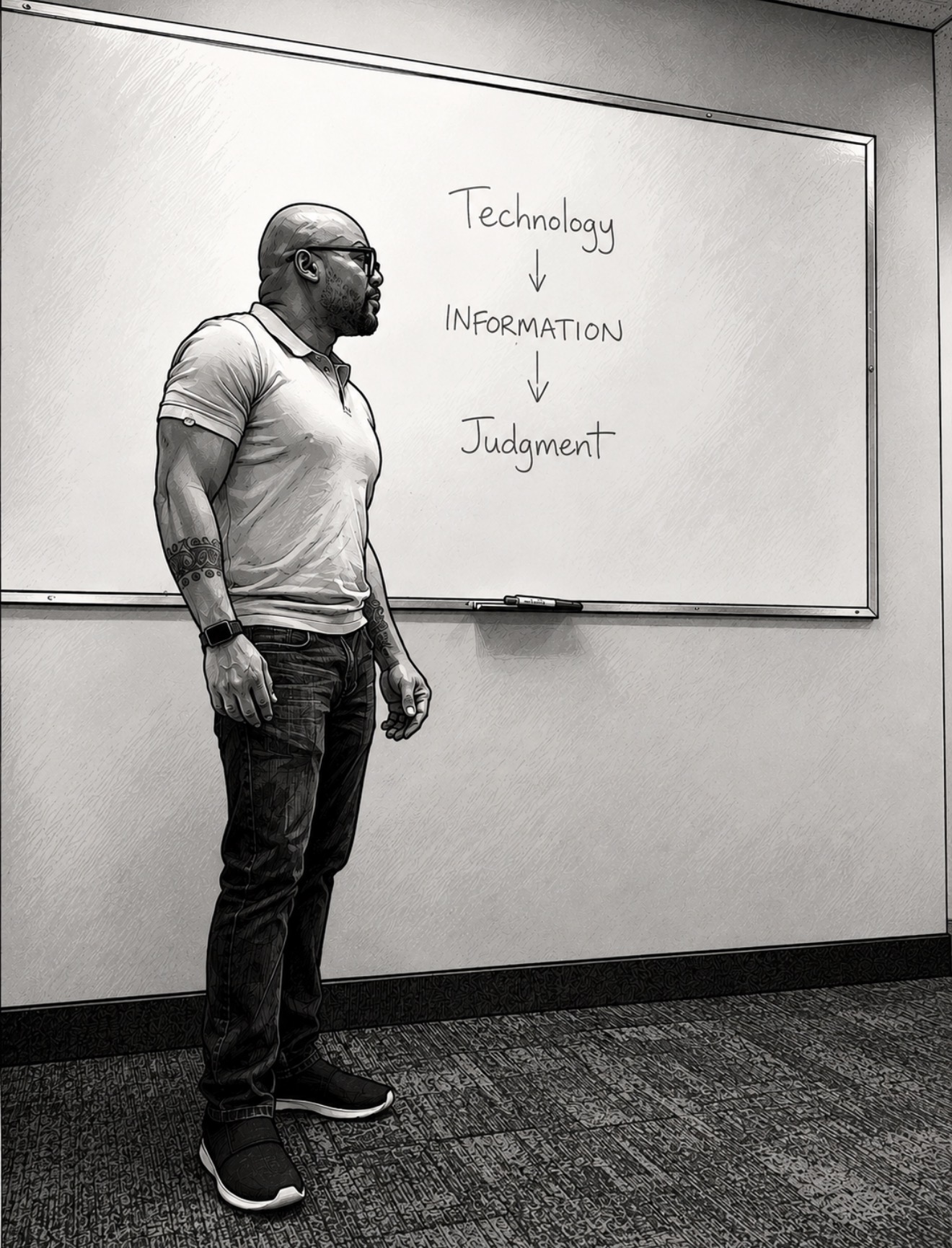
The challenge is that efficiency is not the same thing as judgment.
Scheduling, for example, appears to be a relatively straightforward optimization problem. An algorithm can predict customer traffic, recommend staffing levels, and minimize labour costs with remarkable precision. What it cannot fully appreciate are the realities that rarely appear in a dataset. It cannot understand the employee caring for an aging parent, the single parent trying to coordinate childcare, or the team member who has quietly carried the heaviest workload for months without complaint. Those factors may not influence a mathematical model, yet they often determine whether an employee remains engaged, loyal, and productive over the long term.
This is where leadership becomes irreplaceable. Technology excels at identifying patterns. Leaders must interpret people. The two capabilities complement one another, but they are not interchangeable. An algorithm can recommend a decision. It cannot carry the responsibility, empathy, or accountability required to make one.
Perhaps this is the more important conversation organizations should be having.
For decades, many businesses have measured success by asking, “How can we accomplish more with fewer people?” Increasingly, I wonder whether a better question is, “How can technology help our people create more value?” Those two questions may sound similar, but they lead organizations in very different directions.
One treats people primarily as a cost to optimize. The other recognizes that people are the organization’s greatest source of adaptability, creativity, judgment, and long term competitive advantage. Technology should reduce unnecessary work so that human beings can spend more time doing what only human beings can do.
As artificial intelligence continues to reshape the workplace, I suspect the organizations that distinguish themselves will not simply be those that automate the fastest. They will be those that exercise the wisdom to recognize where automation creates value and where human judgment remains indispensable.
Technology should make better leaders possible.
It should never make leadership optional.





I am a Canadian business owner with a longstanding interest in leadership, strategy and decision making. I write about business, risk, leadership and the systems and incentives that shape how people and organizations make decisions.
Chazz.ca is my personal writing project and a place to explore ideas drawn from experience, education, reading and conversations with people building and leading organizations.
Leave a Reply